Commodity price, Commodity risk, Energy crisis, Hedging, Market psychology, Market trends, Oil market, Risk management, Trading, Trend following

Six Principles To Adopting Best Practices In Commodity Price Hedging

  • This week Sinopec disclosed the latest hedging mishap, losing $690 million amid last year’s oil price collapse.
  • Unless price risk management is organized as an integral part of core business operations, it can devolve into eratic and risky game of speculation that can cause massive damage.
  • The six simple but important guiding principles could help commodity firms create a world class risk management process and turn price risk into a source of value and competitive advantage.

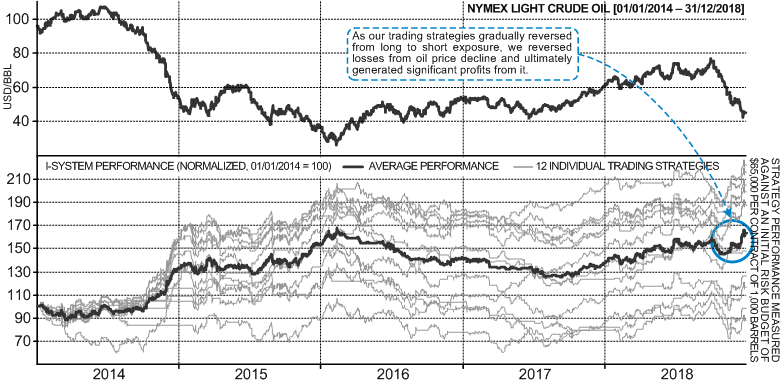
This week Sinopec disclosed that it had incurred $690 million in losses in the fourth quarter of 2018. The losses were attributed to Unipec’s oil hedging bets. Unipec clearly took the wrong directional exposure to oil prices in the period when they staged a sharp, 40% collapse (October-December 2018). This much is understandable. However, such losses did not need to happen – I maintained heavy exposure to oil prices over the same period and not only avoided heavy losses but actually generated significant profits by simply adhering to a systematic trend-following model.
Continue reading

Standard
Commodity price, Commodity risk, Economics, Energy crisis, Hedging, Inflation, Market research, Market trends, Oil market, Politics, Risk management, Trading

The coming oil price shock: could the crisis in Venezuela trigger an energy crisis?

Measured by historical standards, the price of oil has been extremely volatile in recent years. From over $114 per barrel in the summer of 2014 it collapsed more than 75% in only 18 months’ time. Then it tripled to $86/bbl in October 2018, only to drop by 40% to $52/bbl two months later. The question is, why is the oil price so very volatile? Is the market foreshadowing greater disruptions in the future? A closer look into oil supply and demand fundamentals suggests that a great crisis could be in the making – possibly with alarming repercussions.

The looming oil shortage

In 2012 a report produced by the UK Ministry of Defence predicted that oil prices would rise significantly out to 2040, and by “significantly,” they meant to $500 per barrel. From today’s perspective, this may seem farfetched. However, we should not dismiss UKMOD’s warning lightly. This could turn out to be the most important development facing humanity for decades to come. Continue reading

Standard
Asset management, Commodity price, Commodity risk, Economics, Hedging, Market trends, Risk management, Trading, Trend following

How trend following can help industry hedgers: the Palladium edition

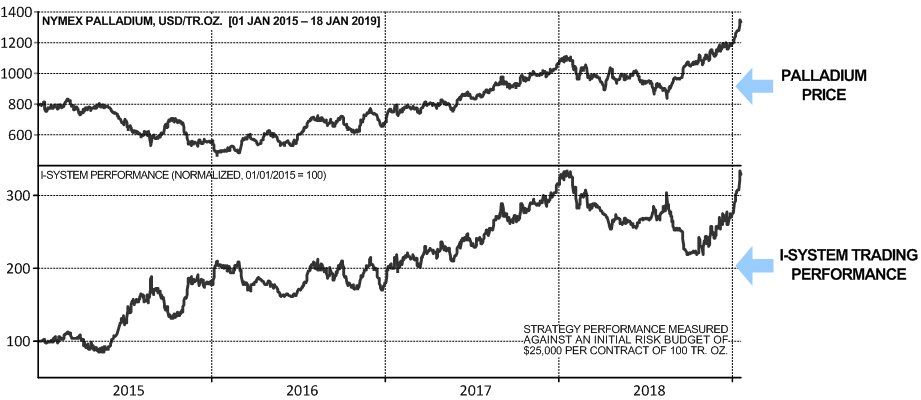
Palladium price has more than doubled since the early 2016 making the white metal more valuable than gold for the first time since 2002. Its impressive performance attracted much attention from the financial press, which published numerous articles and analyses about the palladium market. If you diligently read the analyses, you may learn that automotive industry accounts for some 75% of demand for palladium, that its global production is as little as about 200 metric tons per year (vs. about 3,000 tons for gold), that only two countries (Russia and South Africa) produce more than three quarters of its global supply, and that the demand for palladium is expected to continue to grow. Presumably that implies that palladium price should remain high and possibly continue to rise. Continue reading

Standard
Asset management, Behavioral finance, Risk management, Trading, Trend following

On model risk in quantitative trading

  • Quantitative strategies have become increasingly popular in trading and investing
  • The experience with using them has been mixed, largely as a result of three categories of problems
  • Still, quantitative approach is well worth exploring and offers important advantages to their users

Over the past few years, the use of quantitative strategies has become increasingly popular in trading and investment management. According to JPMorgan, passive and quantitative investors now account for 60% of equity assets under management (vs. 30% ten years ago) and only about 10% of trading volumes originate from fundamental discretionary traders.[1] Appealing new buzzwords like, robo-advising, artificial intelligence and machine learning stoked the imagination of many investors and boosted the quantitative trading gold rush. Continue reading

Standard
Commodity price, Commodity risk, Hedging, Oil market, Risk management, Trading, Trend following

Groupthink in commodity price forecasting, its disastrous consequences and how to master price uncertainty

  • In financial and commodity markets, large-scale price events are not predictable. Even so, most market professionals rely on forecasts most heavily in making forward-looking decisions.
  • At times, this has disastrous consequences (see below)
  • Large-scale price events are far and away the greatest source of external risk for commodity-related businesses. Their severity and frequency has been on the increase in recent years.
  • An alternative approach to mastering uncertainty is to explore systematic trend-following strategies which, if used appropriately can turn price risk into a source of profit and hard to match competitive advantage


According to the latest Reuters survey, over one thousand energy market professionals expect the oil price to average between $65 and $70 a barrel in the years 2019 through 2023. Only 3% of respondents thought that Brent Crude Oil might increase above $90/bbl next year. So, market experts do not expect any surprises and largely agree that oil price will remain where it is. This groupthink reminds me of a similar situation some 15 years ago. Continue reading

Standard
Asset management, Commodity price, Commodity risk, Hedging, Market trends, Oil market, Risk management, Trading, Trend following, Uncategorized

How we navigated the oil price roller coaster

Extreme price events are far and away the greatest source of external risk facing oil and gas producers and other energy-dependent companies. Frequency and severity of such events has been increasing dramatically since about 2005/2006 causing ocasionally severe pain for many industry participants.

Case in point was the 70% oil price collapse through 2014 and 2015, from over $100 to below $30 per barrel. In the aftermath of this decline, U.S. mining industry – which includes oil and gas producers – reported losses of $227 billion, wiping out eight previous years’ worth of profits as the following chart shows: Continue reading

Standard
Something completely different, War and peace

Skullduggery

Today I break my rule to only post on my own articles at this blog. The following article by a person who preferred to remain anonymous struck me as such a disturbingly powerful punch in the gut, I decided to post it here amongst my scribblings. A different style, different imagination… stuff that makes the writer in me slightly jelaous… It is a first-person account written fom the viewpoint of Bill Browder, the protagonist of my book “Grand Deception” (which was twice stricken from Amazon by Bill Browder’s lawyers). Here goes:

Continue reading

Standard
Eurasia, History, Politics, War and peace

Is Vladimir Putin evil? (3/3): the corruption thing

One of the main themes used to demonize Putin in the west are the incessant insinuations that he is corrupt and that his corruption enabled him to build up a massive personal wealth. But while these allegations are invariably presented with zero evidence, we do have some evidence that Putin is in fact not corrupt (at least not in the way it is being implied in western media – but this will be a topic for another discussion). I found the testimony from Sharon Tennison very interesting in this regard as well. Tennison is the founder and president of Center for Citizen Initiatives (CCI) and had worked in Russia (and the USSR) for 30 years. In the course of her activities, she has had at least one personal encounter with Putin and had over the years came to know many other American officials and businessmen who had worked with him. According to Tennison, none of those officials “would describe [Putin] as ‘brutal,’ or ‘thuggish,’ or other slanderous adjectives and nouns that are repeatedly used in western media.Continue reading

Standard
Eurasia, History, Politics, Truth, War and peace

Is Vladimir Putin evil? (2/3)

Almost from the very start of his presidency, Vladimir Putin has been relentlessly vilified in the western media. If their portrayal of Mr. Putin reflected the objective truth, we should believe that the man has no redeeming qualities whatsoever. As I noted in the first in this series of excerpts from “Grand Deception,” systematic demonization of a nation’s leader predisposes many people to consent to war or regime change as means to help a stricken nation rid itself of a rotten, tyrannical leader. If we detest Vladimir Putin, we might approve of our intelligence communities orchestrating a coup to throw him out of power, even if the blood of some Russians is spilled in the process. It should be an honorable deed done for a greater good. Indeed, those who are desperate to have a regime change in Russia should be very keen for us to detest Mr. Putin. Hence the nonstop, un-nuanced negative coverage. Here I offer a different perspective: what if Putin isn’t an arch-villain? What if he does in fact have redeeming qualities? Should we not try to get to know the man a bit better before we shrug off another regime change or war to rid the world of tyrants? Continue reading

Standard
Eurasia, History, Politics, Truth

Is Vladimir Putin evil? (1/3)

Western corporate media has cast Vladimir Putin as the main villain of today’s geopolitics. If their coverage of Russia’s president were truthful and objective, we’d have to conclude that Putin has no redeeming qualities whatsoever, that he is the greediest, most ruthless tyrant since Genghis Khan and that he had turned his government into a lawless mafia state. Indeed, unflattering, negative coverage of Vladimir Putin is pervasive, but where concrete evidence should be presented, ceaseless repetition of allegations is taken as sufficient proof.

Joseph Goebbels’ technique of the big lie entails deceiving people with big, brazen lies and repeating them unrelentingly. If truth is to set us free, we must spread it with boldness and determination. We must push back and expose the lies. They who desire wars are few, and we who desire peace are many. Even if they can silence some of us, they can not silence us all. Do your part, reject fear and the lies, and together we can put an end to today’s dystopian state of permanent war. Continue reading

Standard