Asset management, Behavioral finance, Commodity price, Complexity, Economics, Expertise, Hedging, Market psychology, Psychology, Stock market, Trading, Trend following

The illusion of expertise in financial markets

Participants in financial markets have to deal with uncertainty on a daily basis. Their need to research and understand markets has given rise to a massive industry delivering security prices, reports and expert analyses to traders and investors seeking to make sense of the markets and predict how they might unfold in the future.

The need to understand stuff is innate to our psychology: when something happens, we almost reflexively want to know why it happened. But the compulsion to pair an effect with its cause sometimes gets us jumping to conclusions. If such conclusions turn out to be mistaken or irrelevant, they could prove useless – or something worse. Consider two recent titles from the ZeroHedge blog, published 89 minutes apart: Continue reading
Standard
Commodity price, Economics, Energy crisis, Hedging, Market research, Oil market, Trading

Saudis to unveil the big secret? Not likely.

Over at OilPrice.com Nick Cunningham wrote that Saudi Arabia might finally reveal one of its closest kept secrets as they prepare to sell some 5% of its oil monopoly, Saudi Aramco, to the public. The Saudis and their Wall Street bankers expect Aramco to be valued at $2 to $3 trillion, which would generate north of $100 billion for the Saudis and massive underwriting fees for Wall Street Banks.

Since both the Saudis and Wall Street hope for the highest possible valuation for Aramco, we should not expect that they’ll “unveil” anything less than the rosiest plausible figure for their oil reserves. Continue reading

Standard
Asset management, Commodity risk, Complexity, Economics, Expertise, Hedging, Market research, Policy, Risk management

Economic forecasting is exercise in futility

Economists can’t forecast for a toffee… They have missed every recession in the last four decades. And it isn’t just growth that economists can’t forecast; it’s also inflation, bond yields, unemployment, stock market price targets and pretty much everything else.” – James Montier

Forecasting commodity prices and economic indicators is demonstrably an exercise in futility. Our markets and economies are complex systems and as such, their future unfolding is impossible to predict with any degree of certainty. Concretely, let’s take a look at how the leading economic analysts did at predicting oil prices, GDP growth, unemployment and stock market indices. Continue reading

Standard
Commodity price, Commodity risk, Hedging, Risk management, Trend following

Risk, Uncertainty and Profit

Frank Knight, the grand old man of Chicago wrote “Risk, Uncertainty and Profit,” one of the five most important economics books of the 20th century. Among other invaluable insights, Knight proposes that, “The responsible decisions in organized economic life are price decisions; others can be reduced to routine.” Knight recognized that price at which a firm sells its products or purchases materials tends to have greater impact on profitability than any other element. Based on the income statement of an average S&P 1500 company (and assuming constant sales volumes), a 1% improvement in the selling price would generate an 8% increase in operating profits. Conversely, a 1% drop in the cost of goods sold would lead to a 5.36% increase in operating profits. This impact was more than double that of a 1% increase in sales volume[1]. For commodity businesses where operating margins are typically very low, hedging can have a much greater impact on profitability. Continue reading

Standard
Asset management, Commodity price, Commodity risk, Hedging, Risk management, Trend following

Lessons in trend following: how we traded sugar

Sugar prices have soared on the CSCE (Coffee, Sugar and Cocoa exchange) from just over $0.10 per pound in August 2015 to over $0.23 at present – a fairly sharp jump by any standard, particularly after several years of continuously falling prices. I trade sugar using our trend-following model and to channel my inner Donald Trump – we’ve done tremendously well, generating a respectable grosss annualized return of nearly 10% per annum over a 5-year period. Now, the main reason I find this remarkable is that I know next to nothing about the fundamental economics of the sugar market. I know it goes into biscuits and beverages, that it comes from sugar cane or sugar beets, but that’s about it. Continue reading

Standard
Asset management, Behavioral finance, Commodity price, Commodity risk, Economics, Hedging, Market research, Market trends, Psychology, Risk management, Trend following

Harnessing market trends to manage commodity price risk

On 24th September 2015, David Stein (M Sc., CFA, President and CEO of Aberdeen International[1]) wrote a compelling article analyzing the expected effect of last year’s VolksWagen emissions scandal on palladium and platinum markets that should be of great interest to commodity traders and industry. Continue reading

Standard
Asset management, Commodity price, Economics, Hedging, Trend following, Uncategorized

“Mastering Uncertainty” receives its first review

I’ve recently published my book, “Mastering Uncertainty in Commodities Trading” which has now obtained its first reader review on Amazon, and it’s a five stars review! For a first-time author, this is Christmas! Heartfelt thanks to Roman for taking time to read the book, “get it,” and post this flattering review. I’m posting the full text, titled “Exceptionally well written book,” below: Continue reading

Standard
Commodity price, Energy crisis, Hedging, Market research, Market trends, Oil market, Trend following

5/5: $500 oil and how to manage the looming uncertainty and risk

Let us recap what we covered in parts 1, 2, 3 and 4 of this report. In spite of the low price of oil (just below $50 at the time of this writing) and predominantly bearish market sentiment, the “big picture” suggests that we are facing a grave energy predicament. Petroleum producing countries, especially members of OPEC, have been vastly overstating their oil reserves. Production of oil from conventional sources is in an irreversible decline. Over the next 15 years, the EIA projected that production will fall over 40% short of demand. New drilling technologies, and this includes fracking, are unlikely to impact this shortfall in a meaningful way.  These conditions have led the UK’s Ministry of Defence to predict in 2012 that oil price could rise to as high as $500 per barrel over the next three decades, causing crises of unforeseeable proportions. For the oil market participants, the trillion dollar question is how to cope with the looming uncertainty and risks. Continue reading

Standard
Commodity price, Economics, Energy crisis, Hedging, Market psychology, Oil market, Uncategorized

4/5: Sources and quality of oil market information

This posting is part 4 in the 5-part series on the future energy crisis we are likely facing. Here are parts one, two, and three. My research to try and establish facts about oil supply and demand led to many dead-ends where you must take the information at face value and hope that it is true. For example, we’ve all heard (again) about tanker-fulls of unsold crude oil floating around the world, but ultimately, this information was based on hearsay. For example, Bloomberg reported how oil companies are seeking supertankers to store 20 million barrels of crude oil [i] (that sounds like a lot, but it represents only a few hours’ worth of global demand). Continue reading

Standard
Commodity price, Economics, Energy crisis, Hedging, Market research, Oil market

1/5: Making sense of Saudi Arabia’s oil reserves and production capacity

UPDATE: This article is part of a 5-part series posted in 2016. Latest oil market related article is here: “The coming oil price shock

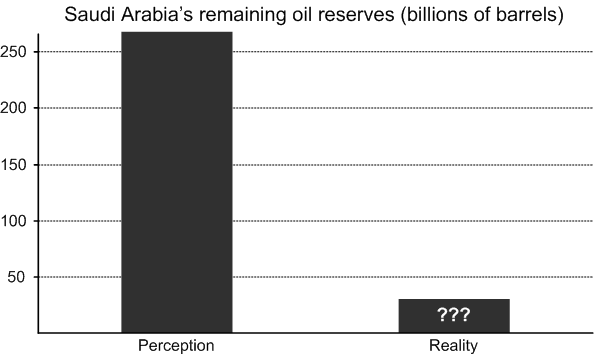
So, the question is, why did oil prices suddenly collapse in 2014 and continued slumping into 2016? Neither U.S. fracking boom nor the slow demand growth can explain the event’s timing. We’ve known about fracking since at least 2009 and the “boom” part became quite apparent by 2011. The weakness in global demand wasn’t news either, so what did happen in June 2014 when oil prices collapsed? Supposedly, this had something to do with Saudi Arabia’s refusal to curb excess production for whatever reason – there has been no shortage of explanations. Saudi Arabia is the world’s biggest oil producing powerhouse endowed with virtually inexhaustible reserves of the black gold and the capability to switch the taps on or off and move global oil supply and prices at will. That, at any rate is what the mainstream media narrative would have us believe. However, if we scratch the gloss off that narrative, the situation appears starkly different: Continue reading

Standard