
On 24th September 2015, David Stein (M Sc., CFA, President and CEO of Aberdeen International[1]) wrote a compelling article analyzing the expected effect of last year’s VolksWagen emissions scandal on palladium and platinum markets that should be of great interest to commodity traders and industry. Continue reading
Category Archives: Economics
Don’t go jumping to conclusions…
… especially if you are dealing with abstract or complex problems. We do have something of a tendency to fall into misconceptions and cognitive errors through “conscious theorizing“. That’s quite a word salad so let me explain…
“Mastering Uncertainty” receives its first review
I’ve recently published my book, “Mastering Uncertainty in Commodities Trading” which has now obtained its first reader review on Amazon, and it’s a five stars review! For a first-time author, this is Christmas! Heartfelt thanks to Roman for taking time to read the book, “get it,” and post this flattering review. I’m posting the full text, titled “Exceptionally well written book,” below: Continue reading
Investing in the age of unprecedented monetary experiments
Since the 2008 financial crisis, world’s largest central banks have unleashed a program of monetary stimulus that dwarfs anything we’ve experienced in history. With no historical precedents, how should investors navigate the risks and events that will likely exert extreme stress upon political, economic and social fabric of nations across the world. Altana Wealth’s founder Lee Robinon offers some unorthodox insights in a 45 minute interview with Real Vision TV with Grant Williams. You may not hear similar thinking from academics or CNBC-vetted pundits. Lee has the remarkable capacity to keep a mind-bogglingly detailed mental map of what’s going on in the world of business, finance and politics within a clear historical perspective and isn’t shy about laying it out as he sees it. The video is below: Continue reading

Central banks – what are they good for?
In 1912, the United States had no central bank and no personal income tax. It nevertheless managed to generate a $3 million fiscal surplus. Today, after a century of Federal Reserve’s management of the nation’s currency, the country is mired in unpayable debts, unending overseas military adventures and massive fiscal (and trade) deficits. Here’s a comparison, courtesy of Jim Quinn (the Burning Platform blog): Continue reading
Eurasian integration and the future of humanity
Developed world has come to a fork in the road. One of the paths leads in the direction of general military conflagration as the empire aggressively seeks to assert its dominance, bludgeoning every independent-leaning nation into submission. The other path leads toward peaceful economic integation, growth, cooperation and trade across the old continent. Western political elites, working on behalf of corporate interests seem to be doing their utmost to lead us into another World War. Meanwhile those independent-leaning nations are building bridges of cooperation and trade. A recent article by F. William Engdahl provides an excellent take on how that path is being forged. This could be one of the defining stories of humanity’s future. Continue reading
4/5: Sources and quality of oil market information
This posting is part 4 in the 5-part series on the future energy crisis we are likely facing. Here are parts one, two, and three. My research to try and establish facts about oil supply and demand led to many dead-ends where you must take the information at face value and hope that it is true. For example, we’ve all heard (again) about tanker-fulls of unsold crude oil floating around the world, but ultimately, this information was based on hearsay. For example, Bloomberg reported how oil companies are seeking supertankers to store 20 million barrels of crude oil [i] (that sounds like a lot, but it represents only a few hours’ worth of global demand). Continue reading
1/5: Making sense of Saudi Arabia’s oil reserves and production capacity
UPDATE: This article is part of a 5-part series posted in 2016. Latest oil market related article is here: “The coming oil price shock”
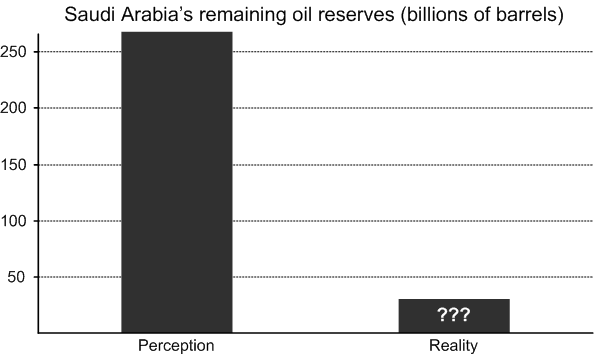
So, the question is, why did oil prices suddenly collapse in 2014 and continued slumping into 2016? Neither U.S. fracking boom nor the slow demand growth can explain the event’s timing. We’ve known about fracking since at least 2009 and the “boom” part became quite apparent by 2011. The weakness in global demand wasn’t news either, so what did happen in June 2014 when oil prices collapsed? Supposedly, this had something to do with Saudi Arabia’s refusal to curb excess production for whatever reason – there has been no shortage of explanations. Saudi Arabia is the world’s biggest oil producing powerhouse endowed with virtually inexhaustible reserves of the black gold and the capability to switch the taps on or off and move global oil supply and prices at will. That, at any rate is what the mainstream media narrative would have us believe. However, if we scratch the gloss off that narrative, the situation appears starkly different: Continue reading
Economic growth is not a sustainable policy objective
It goes without saying that the key policy objective of fiscal and monetary authorities world over is to achieve and sustain economic growth. This unthinking adherence to orthodoxy is very unfortunate. We cannot hope to solve society’s problems unless we formulate the problems correctly. And we can’t formulate them correctly if we set inappropriate goals.
A while back, Jeremy Grantham made an illuminating projection: suppose that in 3030 B.C. the total possession of the people of Egypt filled a box measuring 1 cubic meter. Suppose further these possessions grew at a rate of 4.5% per annum. How large should this hoard get 3000 years later, in 30 B.C.?
Market facts vs. market narratives
So the economy is in the doldrums globally and demand for oil languishes. At the same time, oil producing countries are pumping the stuff out as hard as they can with no let-up in sight. So how does it make sense that oil price surged nearly 60% from its January lows? Today’s news and rumors may explain today’s advance, but what about previous three months’ rally? The answer is that over time, it is the price that leads the narrative, not the other way around. I’ll try to elaborate.
 The Naked Hedgie